
Standard Operating Procedure
Window and Gutter Cleaning
Purpose:
To outline safe work steps for external building maintenance.
Pre-Arrival:
Check weather forecasts. Avoid high-wind or heavy-storm conditions. Reliable Windows will not work during prolonged heavy rain spells.
To maintain operational reliability, Reliable Windows will work in some inclement weather conditions.
This includes, light rain and windy conditions.
Customers have the right to opt out of their routine clean if they choose. Their next clean would then be scheduled to their next due date depending on their requested frequency.
Where possible, texts are sent to customers the afternoon/evening before the day of their clean , at which point, an unwanted clean should be cancelled by reply text, whether due to weather, holiday or any other reason applicable to the customer.
Site Inspection:
Walk the perimeter. Check for overhead power lines, uneven ground, and hidden obstacles.
Equipment Check:
Reliable Windows uses only high quality pure water, with a reading of 0.00 TDS (Total Dissolved Solids), to ensure a streak free clean of all customer windows.
This is checked before starting window cleaning every day.
Visually inspect water-fed poles, hoses, ladders, and Personal Protective Equipment before use.
Public Protection:
Set up high-visibility warning signs where work blocks pedestrian pathways.
Work Execution:
Maintain a firm two-handed grip on poles. Ensure a clear line of sight at all times.
Post-Job:
Pack away all hoses, signage, and equipment immediately to prevent public trip hazards.
Method Statement:
Pure Water-Fed Pole System & Gutter Clearing
Company Name: Reliable Windows
Scope of Work:
Exterior window and frame cleaning via ground-based pure water systems, and manual ground-based gutter vacuum clearing.
Access Method:
100% ground-based telescopic pole operation. No high-level ladder climbing or roof access required for standard clears.
Materials Used:
Pure de-ionized water (no hazardous chemicals or toxic detergents).
Sequence of Operations:
Display "Caution: Wet Surface" safety A-frames on approach pathways.
Run water lines tight against wall edges to keep public footpaths completely clear.
Extend poles systematically from ground level up to 1st/2nd story windows.
Agitate dirt using non-abrasive brush heads and rinse clean.
Clear ground area, roll up hoses, and load safely into the service vehicle.
Risk Assessment
Hazard:
Slips, Trips, and Falls (Trailing Hoses / Wet Surfaces)
Who is at Risk:
Operatives and the General Public.
Control Measures:
Hoses run flush against building bases.
High-vis warning signage displayed.
Suitable Personal Protective Equipment worn.
Hazard:
Working Near Overhead Power Lines
Who is at Risk:
Operatives.
Control Measures:
Pre-work site scan.
Maintain a minimum 6-meter distance with carbon-fiber poles.
Hazard:
Falling Debris (Gutter Clearing)
Who is at Risk:
General Public.
Control Measures:
Establish an exclusion zone directly under the working area using cones or warning signs.
Hazard:
Water Contact with Electrical Equipment
Who is at Risk:
Operatives and Property Outlets.
Control Measures:
Do not spray water directly at external power sockets, meter boxes, or exposed wiring.
Hazard
Working from Height
Who is at Risk
Operatives
Control Measures
Regular training on ladder-work safety.
Ladder footed at all times operatives working on ladder.
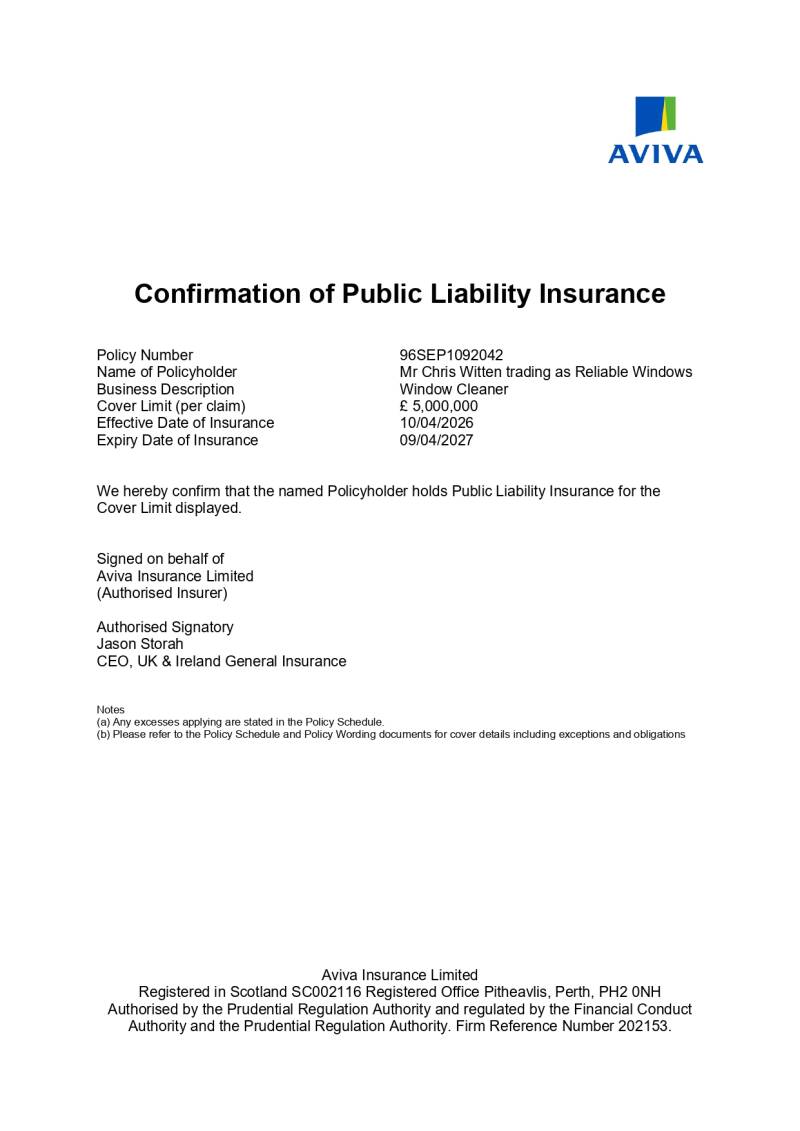
Public Liability Insurance